What to see in Normandy, from Merville-Franceville-Plage
Between the mouth of the Orne and the Pays d'Auge, this stretch of coast holds several Normandies at once: the Normandy of 6 June 1944, the Normandy of cheese and cider, the Normandy of Belle Époque seaside resorts, and the Normandy of the great sites — Bayeux, Honfleur, Mont-Saint-Michel. Here is what there is to see, to taste and to know, with the driving time from the apartment.
This guide accompanies our holiday rental in Merville-Franceville-Plage, a private courtyard one minute’s walk from the beach.
Normandy, the Calvados, and exactly where you are
Understanding the region makes the stay far more interesting — and explains why so much history happened right here.
A region born of a deal with the Vikings
In 911 the king of France handed a Viking leader, Rollo, the lands around the lower Seine in exchange for peace and his conversion. These “men of the North” — Northmanni — gave Normandy its name. A century and a half later their descendant William, Duke of Normandy, crossed the Channel and became king of England after the Battle of Hastings in 1066. His fleet sailed from Dives-sur-Mer, ten minutes from here.
That dual identity explains a great deal: the architecture, the long ties with England, and the fact that nine centuries later, in 1944, the crossing was made in the other direction.
The Calvados
The Calvados is the département you are in — Caen is its capital, it has around a hundred kilometres of coastline, and its name is thought to come from rocks off Arromanches. It is also, of course, the name of the apple brandy, whose most prized appellation is precisely that of the Pays d'Auge, the country of hedgerows and half-timbered houses that begins just behind the coast.
The department packs three very different landscapes into less than an hour of driving: the Côte Fleurie, from Cabourg to Honfleur, with its seaside resorts; the D-Day beaches to the west; and inland the Suisse Normande, with its Orne gorges and climbing crags.
Where you are
Merville-Franceville-Plage sits at the mouth of the Orne, at the exact point where the Côte Fleurie begins and the D-Day beaches end. In practice: Cabourg and the Pays d’Auge to the east, Ouistreham, Caen and the landing beaches to the west, and the sea in front of you. It is an unusual position — most visitors have to choose one or the other; here you have both within twenty minutes.
To place it on the scale of France: Paris is about 2 hr 30 away via the A13, Rouen 1 hr 45, Mont-Saint-Michel 2 hr. Normandy suits a week spent radiating out from one base far better than a tour that changes hotel every night.
You are staying at the eastern end of the landings
Merville-Franceville-Plage lies at the mouth of the Orne, facing Ouistreham. This is where the night of 5–6 June 1944 began, several hours before the first landing craft touched the sand.
Why here?
Allied command needed a coastline wide enough to land several divisions abreast, within range of English airfields, and less heavily fortified than the Pas-de-Calais — where the enemy was expecting the attack. The Calvados coast met those conditions. That left the flanks: German reinforcements had to be kept away from the beachhead. To the west, two American airborne divisions; to the east, right here, the British 6th Airborne Division.
The night of 5–6 June, on your doorstep
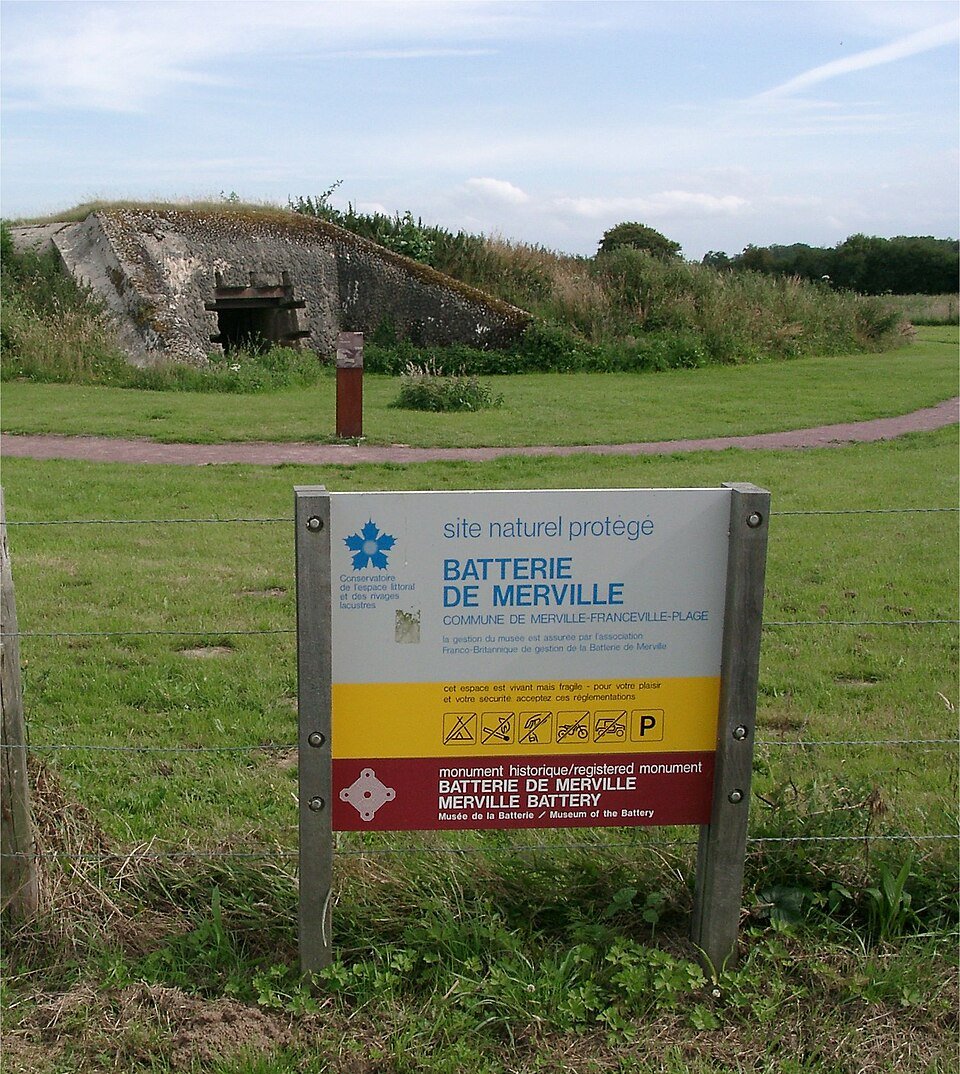
The Merville Battery is the closest site to the apartment and one of the most striking in the area. This German artillery position, protected by concrete casemates, directly threatened Sword Beach — where the British were due to land a few hours later. The 9th British Parachute Battalion was ordered to neutralise it before dawn. The assault went in with only a fraction of the men planned, scattered on the drop, and without most of the heavy equipment; it remains one of the most-told episodes of the eastern sector.
The museum now occupies the original casemates. You move from bunker to bunker, and a Dakota C-47 — the aircraft that dropped the paratroopers — can be visited on site. One casemate has a sound, light and smoke show that recreates the intensity of that night. Allow two hours, and bring a jumper: concrete stays cold, even in August.
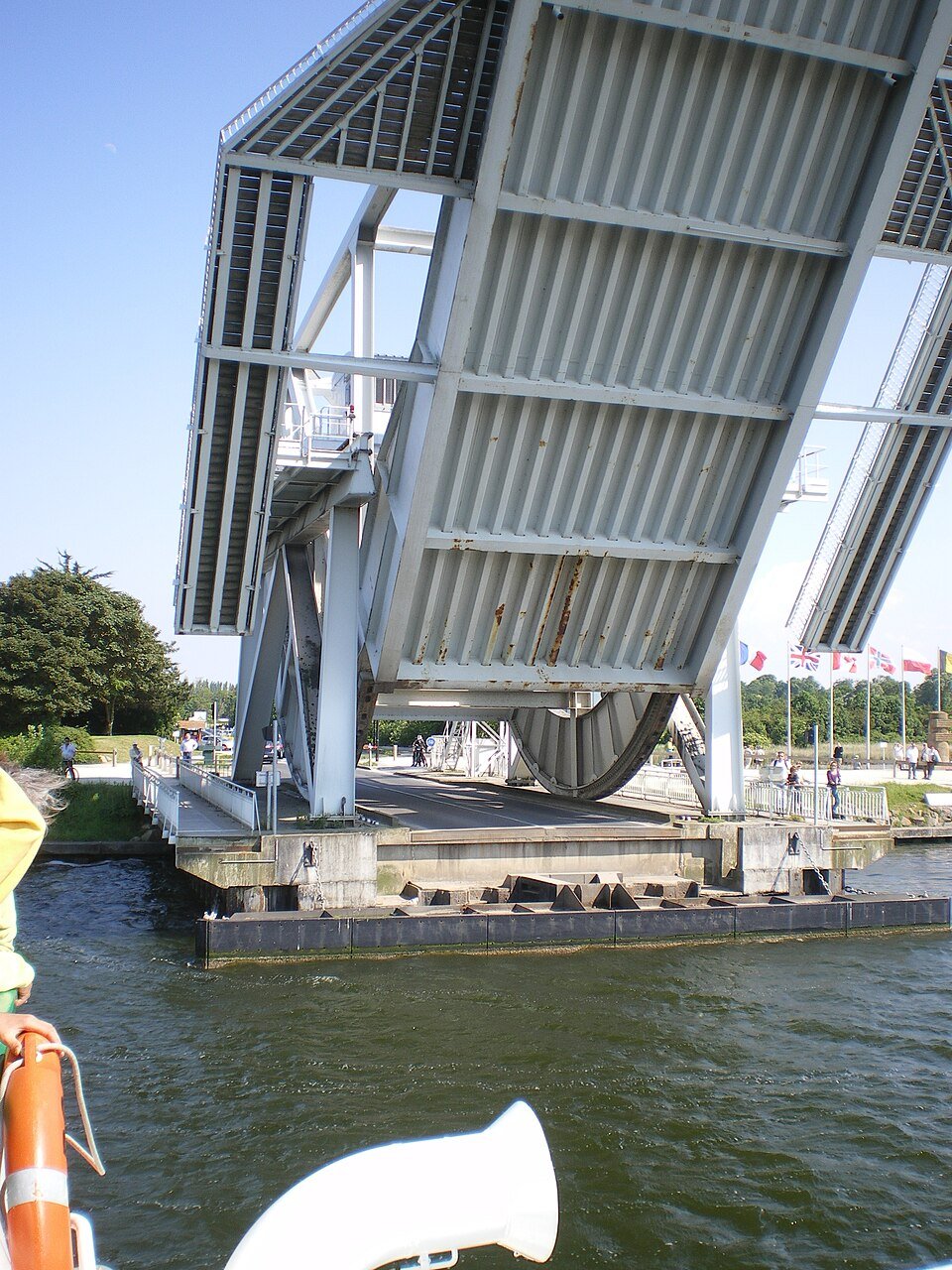
Pegasus Bridge, a quarter of an hour away on the other side of the Orne, was taken by glider in the very first minutes of 6 June. Three aircraft landed in pitch darkness within a few dozen metres of their objective — a feat that has stayed in military history for its precision. The point was to hold the bridge over the Caen canal and stop German armour swinging towards the beaches. The original bridge is now the centrepiece of the Pegasus Memorial at Ranville, one of the first villages in France to be liberated.
The five beaches, east to west
Sword Beach — British
The most easterly, from Ouistreham to Saint-Aubin-sur-Mer. You look across the estuary at it. This is where the Kieffer commando landed, the only French unit engaged on the beaches on 6 June.
Juno Beach — Canadian
Courseulles-sur-Mer. The Juno Beach Centre tells the story of the Canadian war effort, often less well known in Europe than the American or British one.
Gold Beach — British
Arromanches, where the Mulberry artificial harbour was assembled. Concrete caissons are still visible in the bay, especially at low tide.
Omaha Beach — American
The deadliest of 6 June, overlooked by bluffs that gave the defenders every advantage. The Pointe du Hoc, scaled by the Rangers, is a few kilometres away.
Utah Beach — American
The most westerly, on the Cotentin peninsula. Sainte-Mère-Église, one of the first villages liberated, is close by: its church tower is famous.
What followed: the Battle of Normandy
1944 is often reduced to a single day. In reality the fighting lasted nearly three months. Caen, an objective for day one, did not fall until July, at the cost of bombing that destroyed much of the city. The battle ended in August with the closing of the Falaise pocket, where the German army in Normandy was encircled. The landscape you drive through — villages rebuilt in pale stone, new spires on old foundations — still carries the mark of those three months.
Places of remembrance
Four large war cemeteries mark the area, and they are nothing like one another. The American cemetery at Colleville-sur-Mer, above Omaha, ranks thousands of white marble crosses facing the sea. The British cemetery at Bayeux is the largest Commonwealth cemetery of the Second World War in France; every stone carries an epitaph chosen by the family. The German cemetery at La Cambe, dark and low, holds more than twenty thousand men and is visited in an entirely different spirit. And Ranville, very close to here, holds the paratroopers who fell in the first hours.
The Caen Memorial is the place to start if you only do one thing: it is a museum of twentieth-century history rather than a military museum, setting D-Day within the slide to war, the Occupation and the Cold War.
How to plan your visits
Half a day: the Merville Battery, then Pegasus Bridge and Ranville. Everything is within twenty minutes.
A day: the Caen Memorial in the morning, Arromanches and its artificial harbour in the afternoon.
Two days: add Omaha, the Pointe du Hoc, the American cemetery and Bayeux. That is a long day of driving — leave early.
In early June the commemorations draw large crowds and some sites close or are reserved for ceremonies. It is a powerful time to be here, but book far ahead and expect road closures and filtered access.
What people eat and drink here
You are in the Pays d'Auge, which is to say at the heart of what Normandy does best: milk, apples and the sea, often on the same plate.
The cheeses
Four Norman protected-origin cheeses, all made within an hour of here: raw-milk camembert de Normandie; livarot, with the five bands of sedge that earn it the nickname “the colonel”; pont-l’évêque, square and milder; and heart-shaped neufchâtel from the pays de Bray. At a market, say when you plan to eat it: the right degree of ripeness changes everything, especially if you are driving home.
The apple, in all its forms
Cider (dry, medium or sweet), poiré which does the same with pears, pommeau — apple juice fortified with calvados and served chilled as an aperitif — and of course calvados itself, whose Pays d’Auge appellation is the most demanding: double distillation, ageing in oak, and bottles that keep for decades. The Route du Cidre, just inland, links half-timbered villages where you taste at the producer’s own farm — Beuvron-en-Auge, listed among the most beautiful villages in France, is its prettiest stop.
The sea
The harbours at Ouistreham and Dives-sur-Mer land scallops (in season, October to May), sole, mackerel and whelks. Mussels and oysters are available all year. At low tide you can gather shellfish straight from the beach — check the minimum sizes and permitted areas before setting off with a bucket.
Dishes to try once
Teurgoule
Rice pudding baked very slowly with cinnamon until it forms a brown skin. The Norman dessert.
Tripes à la mode de Caen
Simmered for hours with vegetables, cider and calvados. Rustic, and unapologetic.
Sole normande
Poached sole with cream, mussels and prawns. Classic coastal cooking.
Salt-marsh lamb
Raised on the salt meadows of the bays, naturally seasoned by the sea.
Tarte normande
Apples, cream and a dash of calvados.
Le trou normand
A glass of calvados mid-meal. Tradition rather than digestion.
The markets
The one not to miss is the Dives-sur-Mer market on Saturday morning, held under early-fifteenth-century covered halls — a half-timbered roof carried on 66 oak posts, among the best preserved in Normandy. You will find Pays d’Auge cheeses, cider straight from the producers, and fish landed at Dives and Ouistreham. It is under ten minutes by car, and worth the trip for the building alone.
The fish market at Trouville, on the quay, is the other address to know: buy the day’s catch, or eat seafood on the spot. Merville-Franceville also has its own shops five minutes’ walk from the apartment: bakery, butcher, greengrocer and mini-market.
A beach that changes twice a day
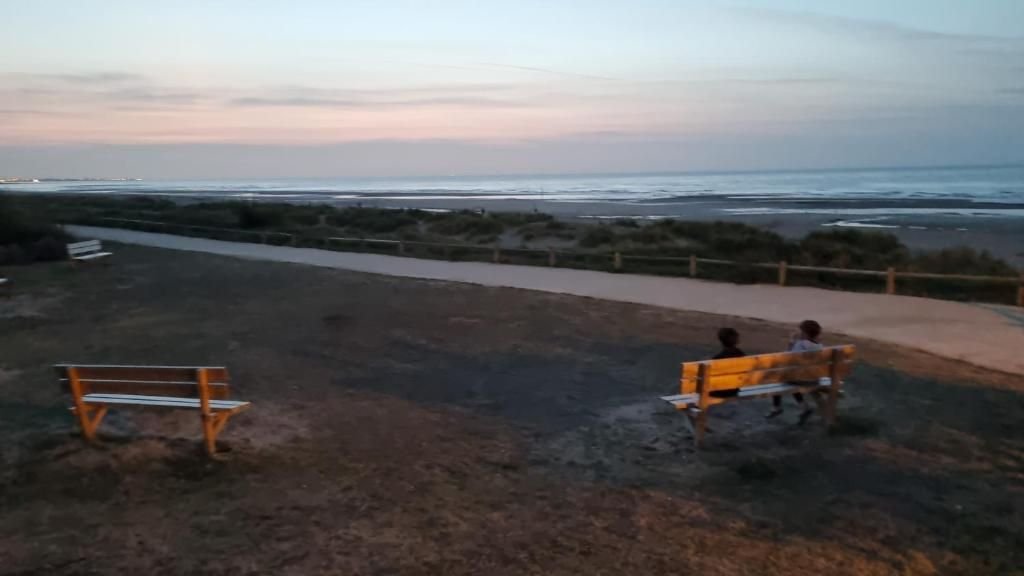
The tide sets the rhythm of the day here. At low tide the sand runs out for several hundred metres; at high tide the sea comes back up to the sea wall.
That range explains everything else: the vast foreshore you can walk on, the land yachting and kitesurfing that make use of the westerly wind, the shellfish gathering, and the giant kites you see in summer. Check the tide table before planning your afternoon — the difference between a 300-metre beach and a 30-metre one is about three hours.
Just east of the village, the Gros Banc bird reserve occupies the mouth of the Orne. Hides let you watch waders and migrating birds without disturbing them; it is one of the few places on this coast where dunes, marsh and estuary meet. Bring binoculars and shoes you do not mind getting wet.
Further east, between Villers-sur-Mer and Houlgate, the Vaches Noires cliffs yield Jurassic fossils with every landslip. The Paléospace museum at Villers explains what you may pick up — and what must be left where it lies. For a longer walk, the GR 223 coastal path, the old customs officers’ trail, follows the shoreline and can be walked in sections.
Inland, the Suisse Normande (about an hour) offers a completely different setting: the gorges of the Orne, climbing crags, kayaking and hiking. A good way to break up a week of beach and remembrance.
The Côte Fleurie, resort by resort
A string of seaside towns born in the nineteenth century, when the railway put the sea within reach of Paris. Each has kept its own character.
Cabourg, five minutes away
The immediate neighbour, and the most literary. Cabourg fans out around its Grand Hôtel, where Marcel Proust stayed regularly and which he turned into “Balbec” in In Search of Lost Time; the seafront promenade now carries his name and is entirely pedestrian — several kilometres facing the sea without a car on it.
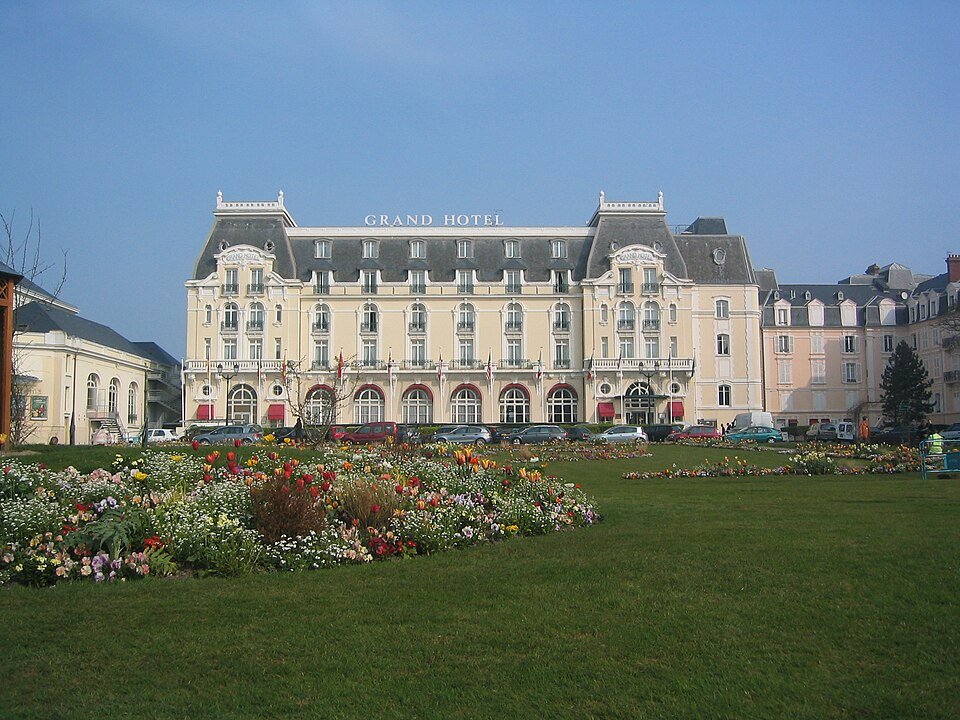
The casino, attached to the Grand Hôtel, belongs to the same Belle Époque ensemble: slot machines, table games, a restaurant and a bar in period surroundings. It has been part of the resort’s identity from the start.
The other local institution is Cabourg racecourse, founded in 1928 and given over entirely to harness racing. Its 1,275-metre sand track hosts more than forty meetings a year, mostly under floodlights in summer — an ideal evening out after the beach. The “Estivales”, on Tuesdays and Fridays through the summer, are built for families: bouncy castles, pony rides, pedal sulkies, a petting farm and stable tours, while the racing goes on. A panoramic restaurant overlooks the track.
Cabourg also hosts a romantic film festival in spring, which brings the town alive out of season — see the year’s key events.
The other resorts
Dives-sur-Mer
The medieval halls and the Saturday market. William the Conqueror’s fleet sailed from here in 1066; today it is the Port-Guillaume marina.
Houlgate
Among the best-preserved Belle Époque villas on the coast, a family beach, and the start of the path to the Vaches Noires cliffs.
Villers-sur-Mer
The Greenwich meridian runs through it. Paléospace museum, fossil beach and a protected marsh.
Deauville
Les Planches, the beach huts, the casino, the racecourses and the American Film Festival in September. The most fashionable resort on the coast.
Trouville-sur-Mer
Directly opposite Deauville and far more down-to-earth: a working fishing port, a fish market, covered halls and a big beach.
The events that shape the year
Some weekends change the mood of the whole coast — and fill every bed for miles months in advance. These are the ones to know about before you pick your dates.
Cidre et Dragon
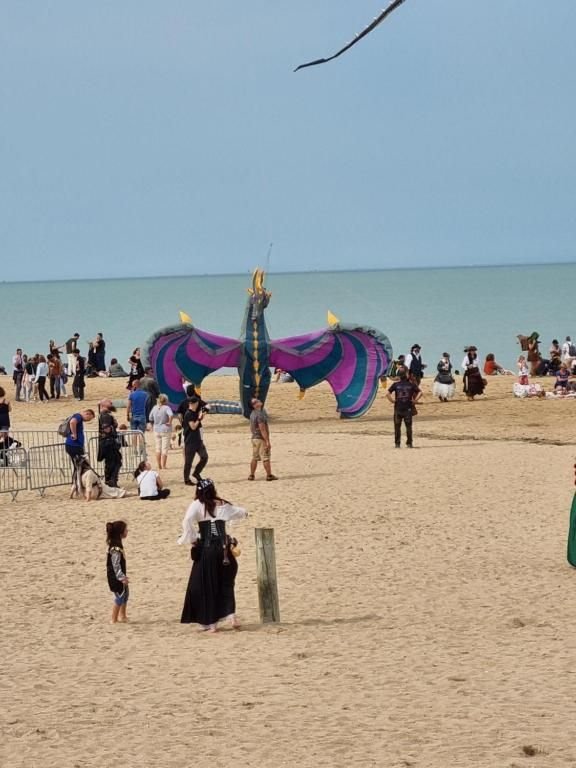
The village’s big event, and one of the largest medieval-fantasy festivals in Europe. On the third weekend of September the seafront becomes “Merravilla”, a temporary city with a medieval market, shows, concerts and tens of thousands of visitors in costume. Entry is free. Next edition: 18–19 September 2027. Book very early — official programme.
The D-Day commemorations
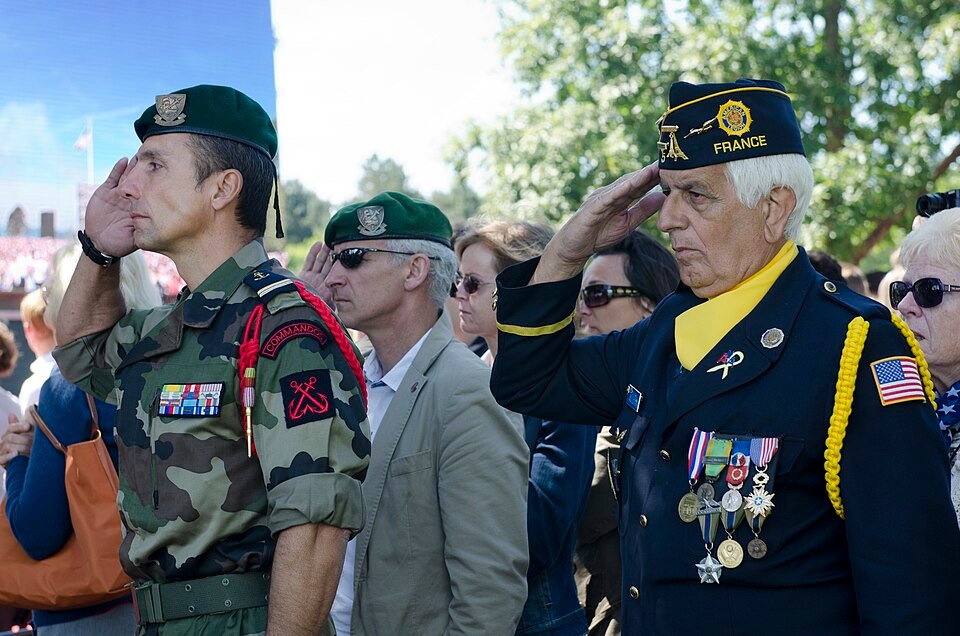
Every year, in the first week of June, ceremonies, parachute drops, parades of period vehicles and firework displays follow one another from Ouistreham to Sainte-Mère-Église. It is a powerful time to be here, with veterans and their families arriving from all over the world — but also the most strained: filtered roads, sites closed to the public, and accommodation booked a year ahead.
The Deauville American Film Festival
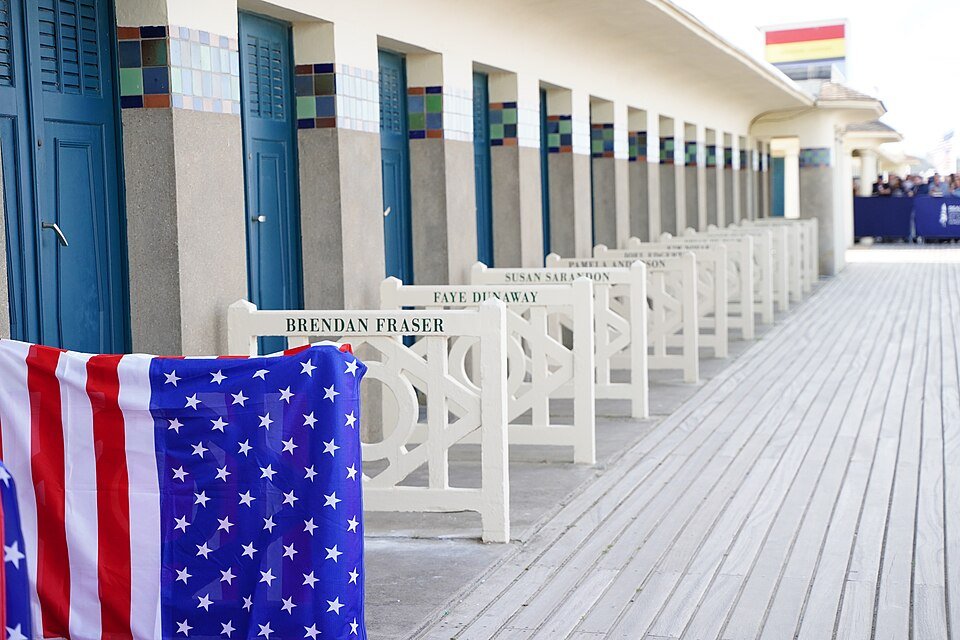
Ten days of premières with film crews over from the United States. Each guest leaves their name on one of the beach huts along Les Planches, so the boardwalk reads like a history of American cinema. 2026 edition: 4–13 September — festival website.
Other dates worth knowing
Cabourg Film Festival — Journées Romantiques
Five days of romantic cinema five minutes from here, with a red carpet on the Marcel-Proust promenade and open-air screenings on the beach. 2026 edition: 10–14 June.
Houlgate Plein Vent
The Côte Fleurie kite festival, free and family-friendly, on the beach at Houlgate a quarter of an hour away: displays, acrobatic championships and taster sessions. It is held in spring, but the dates move each year — check with the town.
The Estivales at Cabourg racecourse
Floodlit harness racing on Tuesdays and Fridays through the summer, with activities for children: bouncy castles, pony rides and stable tours. The easiest evening out in the area.
Dives-sur-Mer market, Saturday morning
Not a festival, but the most reliable fixture of all: Pays d’Auge cheeses, cider from the producers and the day’s fish, under fifteenth-century half-timbered halls. Ten minutes away.
Exact dates move from year to year. The ones given here are for 2026; always confirm with the organisers before booking train or ferry tickets.
Worth a full day, further into Normandy
From Merville-Franceville, most of the great Norman sites work as a day trip, coming back here to sleep.
Caen — 20 minutes
William the Conqueror’s city. Its castle, one of the largest medieval enclosures in Europe, dominates the centre and houses two museums, including a fine art museum well worth the visit. William and his wife Matilda founded two abbeys that answer each other across the city: the Abbaye aux Hommes and the Abbaye aux Dames. Caen, heavily destroyed in 1944, was rebuilt in pale stone around the monuments that survived. Add the Memorial and you have a full day.
Bayeux and its tapestry — 1 hr 10
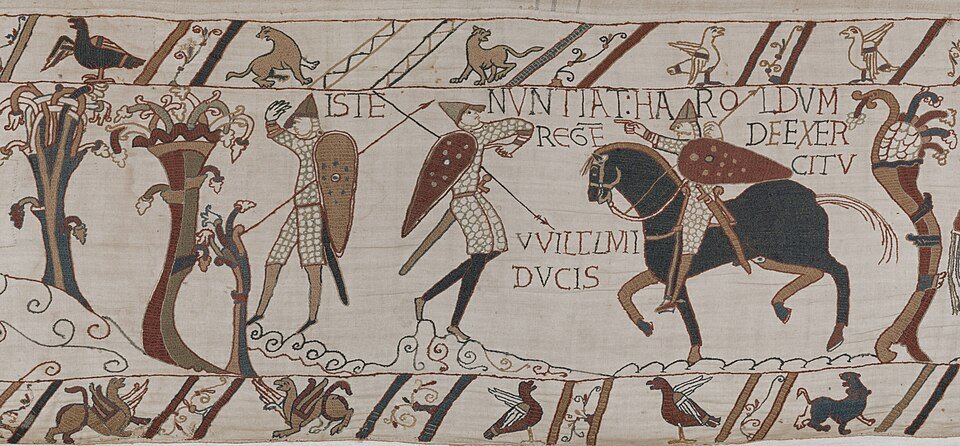
The Bayeux Tapestry is a wool-on-linen embroidery nearly seventy metres long, made in the eleventh century, telling the story of William’s conquest of England — from the Norman side. Inscribed on UNESCO’s Memory of the World register, it is a historical document as much as a work of art: you can read the ships, the weapons, the meals, even the passage of a comet. The town, spared by the fighting and the first large town in France to be liberated, has kept an intact medieval centre around its cathedral, along with the large British war cemetery.
Honfleur — 50 minutes
At the mouth of the Seine, across the Pont de Normandie. The Vieux Bassin, lined with tall narrow slate-fronted houses reflected in the water, is one of the best-known images of Normandy. Sainte-Catherine’s church, built entirely of wood by ships’ carpenters after the Hundred Years’ War, is the largest wooden church in France. Eugène Boudin was born here, and Monet and his friends came to paint the light of the estuary — Impressionism owes a great deal to this coast.
Mont-Saint-Michel — about 2 hours
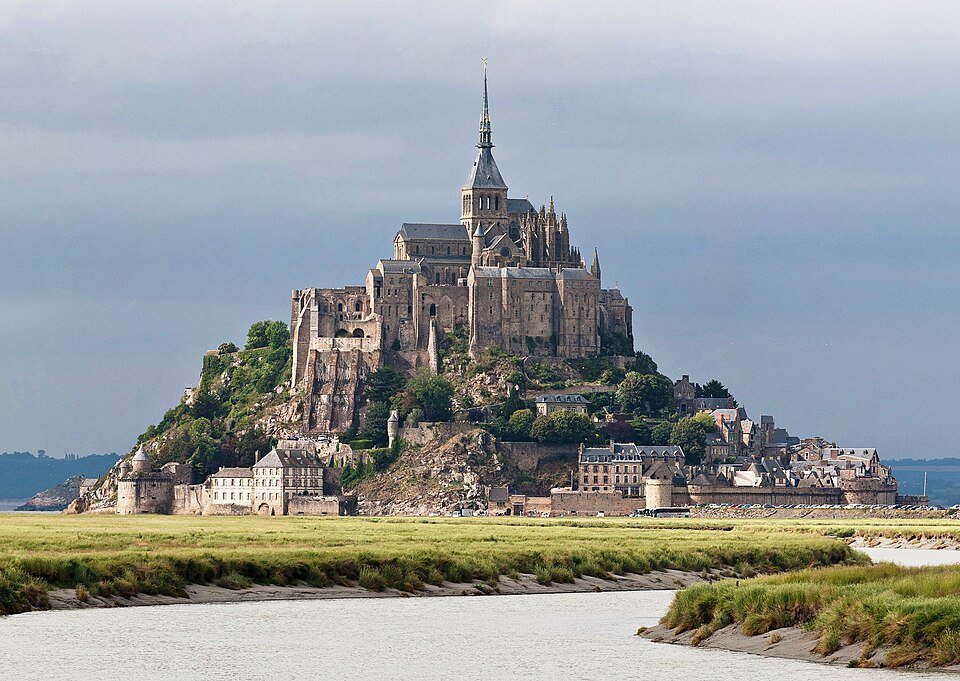
The longest trip, and one you have to earn: allow a full day and leave early. The abbey set on its rock, in the middle of a bay where the tide comes in fast, remains one of the most visited sites in France. A few tips: check the dates of the spring tides, which transform the spectacle completely; visit early in the morning or late in the day to avoid the crowds; and expect to walk, since access is on foot or by shuttle from the car parks.
Étretat and the Alabaster Coast — about 1 hr 30
On the far side of the Seine the landscape changes completely: white chalk cliffs, natural arches and the Aiguille needle, painted by Monet and written about by Maurice Leblanc in Arsène Lupin. The clifftop paths give the best view; they are more demanding than they look.
Rouen — about 1 hr 45
The historic capital of Normandy: the cathedral Monet painted in series at every hour of the day, the half-timbered quarter, the Gros-Horloge, and the square where Joan of Arc was burned in 1431. It can be combined with Giverny and Monet’s house, a little further on.
Caen
Castle, abbeys, Memorial.
Honfleur
Vieux Bassin, wooden church, Impressionism.
Suisse Normande
Orne gorges, climbing, kayaking.
Bayeux
Tapestry, cathedral, British cemetery.
Étretat
Chalk cliffs and natural arches.
Rouen
Cathedral, half-timbering, Joan of Arc.
Mont-Saint-Michel
The abbey and its bay. A full day.
Paris
Via the A13, if you are arriving or leaving through the capital.
When to come, and how
The seasons
July and August are warm and busy: the beach, land yachting, floodlit racing at Cabourg, full terraces. May, June and September are the best compromise — long light, D-Day sites you can actually move around, gentler prices. June is a case apart: the 6 June commemorations mean ceremonies across the whole area, and you need to book well ahead. September too, with the Cidre et Dragon festival here in the village and Deauville next door. Autumn and winter have their following: grey sea, wind, long walks on an empty foreshore, and Norman cooking that makes complete sense when it is cold. The dates are set out under events worth planning around.
Getting here
Portsmouth → Ouistreham
The most direct crossing from England. The port is a quarter of an hour from the apartment, on the other side of the Orne.
Paris Saint-Lazare → Caen
About two hours, then a twenty-minute drive to Merville-Franceville.
From Paris
About 2 hr 30 via the A13. Parking is free along the avenue de la Côte Fleurie.
Caen-Carpiquet
The nearest airport, roughly half an hour away.
Three things that change the stay
Check the tide table in the morning — it governs the beach, the shellfish gathering and even the walk. Bring a car: the village itself is easy on foot, but the landing beaches, the Route du Cidre and the markets all mean driving a little. And keep one day with no plan at all: it is usually the one people remember, somewhere between a market, an empty beach and a bowl of cider on a terrace.
To plan further: Normandy Tourism and the Normandie Cabourg Pays d’Auge tourist office, which covers Merville-Franceville-Plage.
What people ask us most
Which D-Day beach is closest to Merville-Franceville-Plage?
Sword Beach, about fifteen minutes away by road: it starts at Ouistreham, just across the mouth of the Orne. The Merville Battery, the German artillery position that threatened that beach, is in the village itself, two kilometres from the apartment.
How many days do you need for the D-Day beaches?
Half a day covers the eastern sector (Merville Battery, Pegasus Bridge and Ranville, all within twenty minutes). Allow a full day to add the Caen Memorial and Arromanches, and two days if you also want Omaha Beach, the Pointe du Hoc, the American cemetery at Colleville-sur-Mer and Bayeux.
Can you visit Mont-Saint-Michel as a day trip from the Calvados?
Yes. It is about two hours’ drive from Merville-Franceville-Plage, so a full day there and back. Leave early: the site is far quieter before 10am and after 5pm, and access to the rock is on foot or by shuttle from the car parks.
When is the Cidre et Dragon festival at Merville-Franceville-Plage?
The third weekend of September, on the seafront at Merville-Franceville-Plage. Entry is free and the festival draws more than a hundred thousand visitors over two days: accommodation in the village fills up very early, so book several months ahead.
What is the best time of year to visit Normandy?
May, June and September are the best compromise: long days, D-Day sites you can move around, and gentler prices than high summer. July and August are warm and lively but crowded. In early June the 6 June commemorations take over the whole area and you need to book well in advance.
Do you need a car to stay in Merville-Franceville-Plage?
The village works entirely on foot: beach, shops, bakery and restaurants are all five minutes away. The landing beaches, the Route du Cidre, the Pays d’Auge markets and the longer day trips all need driving, though. For a week’s stay a car is strongly recommended.
Published 7 September 2026 · Updated 7 September 2026
Photo credits. The views of the beach at Merville-Franceville-Plage are our own. Merville Battery (Neizham), Pegasus Bridge (Rundvald), Grand Hôtel de Cabourg (Ji-Elle), Mont-Saint-Michel (Diliff), Bayeux Tapestry and the 6 June ceremony (US Air Force): public domain, via Wikimedia Commons. Les Planches at Deauville during the festival: Elyot Boudart, via Wikimedia Commons, under a CC BY-SA 4.0 licence.
A private courtyard, one minute from the beach
Everything above can be visited from Merville-Franceville-Plage. Our apartment opens onto a private 23 m² courtyard, sleeps up to 5 across three sleeping areas, and the beach is one minute’s walk away.